Advisor: Dr. Jennifer Wilcox – Chemical and Biomolecular Engineering department at University of Pennsylvania
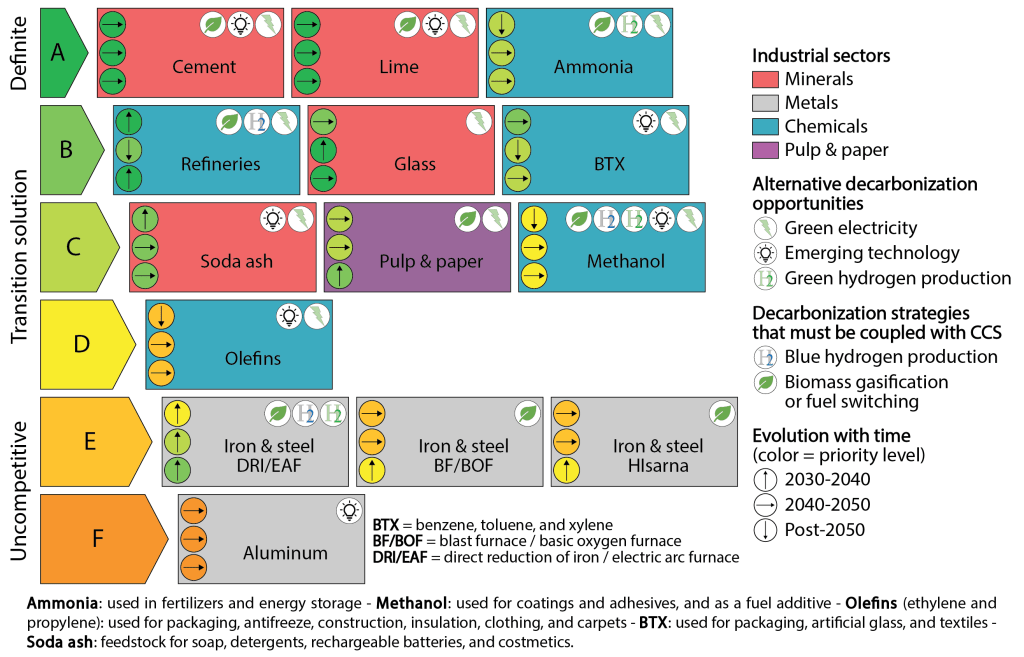
This project evaluates the role of carbon capture and storage (CCS) as a key decarbonization strategy for industrial sectors in the United States, focusing on where and when CCS can have the greatest impact. Using a CCS “ladder,” it prioritizes industrial applications such as mineral-based industries, hydrogen production, and petrochemical processes where CCS can address emissions that are difficult to eliminate through other means. The methodology incorporates criteria like CCS feasibility, CO2 mitigation potential, and readiness of alternative technologies, applied to near- and long-term timeframes.
The analysis highlights CCS’s potential for decarbonizing sectors with significant process emissions, such as cement and lime production, where emissions are unavoidable without CCS. For hydrogen production and petrochemicals, CCS serves as a transitional tool while cleaner technologies mature. Regional factors like access to geologic CO2 storage and renewable energy also influence strategy deployment. While CCS may be a temporary solution for industries like steelmaking, it remains crucial for decarbonizing nearly two-thirds of industrial emissions. This work offers a framework for policymakers to prioritize CCS deployment alongside complementary technologies like electrification and fuel switching, accelerating the pathway to net-zero emissions.
Read the full blog post here!
 Max Pisciotta