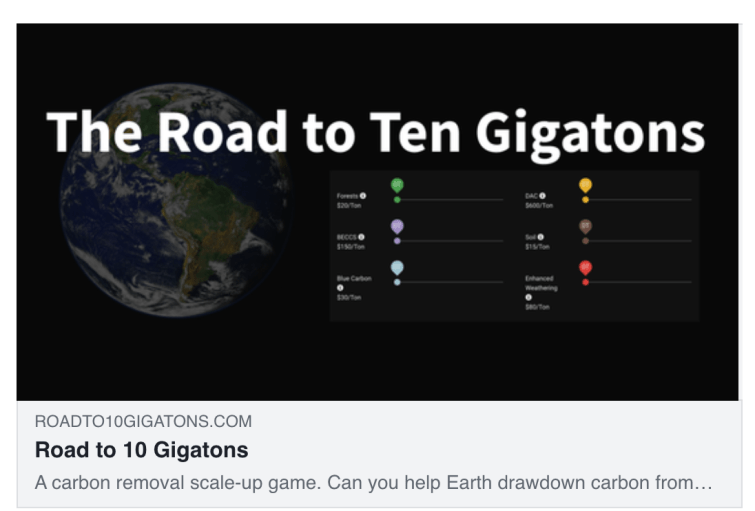
I’m a bit late in posting this, but I’m excited to share a project I’ve been working on with Cassandra Xia and John Sanchez: The Road to 10 Gigatons, a carbon removal scale up game, which launched on Monday!
About nine months ago I was asked if I would be interested in developing a tool that with aim of helping people develop an intuition for what it really means to scale up different carbon removal solutions to the gigatonne scale! At the time I had just finished a pretty intensive literature review, familiarizing myself with the concept of carbon removal through nature-based and engineered solutions. My main finding, and an opinion I whole-heartedly believe, is that to achieve large-scale carbon removal, we need everything. Trees can’t do it on their own, restored wetlands can’t do it on their own, direct air capture (DAC) can’t do it on its own either.
Cass, John, and I set out to develop a game that would help people develop an intuition for scaling these solutions, but also to illustrate that there is no silver-bullet solution to removing carbon dioxide (CO2) from our atmosphere. Our game values and news feed alerts are informed by existing literature on the subject of carbon removal and the specific approaches that are featured. We hope that people will play around with different combinations of CDR approaches and compare the vastly different consequences possible depending on the portfolio of solutions selected.
The underlying model used in the game is inevitably filled with rough approximations and our own assumptions that we do our best to spell out in this accompanying document. We tried to pull relevant numbers and values (like cost/ton or land used/ton of a given solution) from the scientific literature, but we often saw different sources give estimates that varied by several orders of magnitude. Thus, the game should be used for education and science communication purposes and to help build understanding for the broad challenges involved with scaling CDR solutions. It’s not intended for rigorous academic or scientific modeling purposes. We’d love your feedback on the game – whether on the user (player) experience or your thoughts on the model behind the simulation. Feel free to send me a note at mdpisciotta@gmail.com.
 Max Pisciotta